

IN PARTNERSHIP WITH

The U.S. government just moved one step closer to forcing a Central Bank Digital Currency on every American.
They claim it’s about “modernization.” But let’s call it what it really is: full control over your money.
With the digital dollar, Washington bureaucrats could:
Monitor every single purchase you make
Dictate how much you’re allowed to spend
Block what you can (and cannot) buy
Even freeze your account with a single click
The bad news: this may be your last chance to protect your savings.
The good news: there’s still a way to legally opt out — but only if you act before the trap snaps shut.
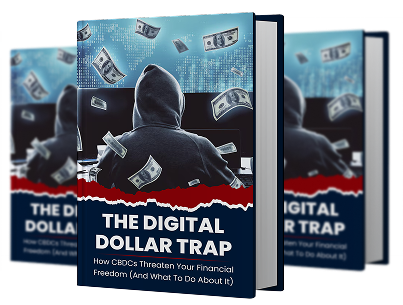
That’s why we put together this urgent new guide: The Digital Dollar Trap.
Inside, you’ll discover exactly what this rule means for your financial freedom — and the simple moves you can take today to protect your cash and privacy.
Please don’t wait. Once the switch is flipped, your choices will vanish overnight.
The digital dollar, once a distant concept, has moved to the center of U.S. monetary debate — and with it, the question of how much privacy remains.
This transformation has accelerated with renewed government interest in Central Bank Digital Currencies (CBDCs), now at the center of national policy discussions.
Yet recent developments suggest a more complex picture emerging—one where the promise of modernization competes directly with deeply held American values of financial privacy and personal autonomy.
The Official Narrative
Federal Reserve officials have historically framed digital currencies around efficiency and inclusion.
But beneath this technological optimism lies a fundamental exchange. Privacy, once considered an inherent feature of cash transactions, becomes a negotiable commodity.
The digital euro’s designers promise “privacy for small transactions”—a vague phrase that leaves “small” conveniently undefined.
Brazil’s Drex pilot program illustrates how quickly efficiency arguments can expand into broader control mechanisms. Initially promoted as infrastructure for financial innovation, Drex incorporates programmable features that enable spending restrictions and automated policy enforcement—capabilities impossible with traditional currency.
|
The Listening Economy
Digital money systems create unprecedented visibility into personal financial behavior.
Recent analysis reveals the scope of this surveillance capability. Programmable money allows for conditional spending—funds that expire if unused, payments that restrict certain purchases, or transfers that require government approval. China's e-CNY trials have demonstrated these features in practice, with authorities testing expiration dates on digital currency to force consumer spending during economic downturns.
The surveillance infrastructure extends beyond transactions to behavioral profiling. Machine learning algorithms can analyze spending patterns to predict everything from political affiliations to health conditions. This capability transforms money from a neutral exchange medium into a comprehensive monitoring system.
Trump's January 2025 executive order banning CBDCs specifically cited these surveillance risks, stating that digital currencies "threaten financial system stability, individual privacy, and US sovereignty". Federal Reserve Chair Jerome Powell subsequently pledged never to launch a CBDC during his tenure, effectively halting development until at least May 2026.
The American Pushback
The resistance to CBDCs reflects deeper cultural tensions around government authority and individual autonomy.
This skepticism has driven Americans toward alternative stores of value. Self-directed IRA investments in precious metals have surged, with gold prices climbing 43% in 2025.
The precious metals market has become a proxy for financial sovereignty concerns. Unlike digital currencies, gold and silver cannot be programmed, monitored, or remotely controlled. Their appeal transcends traditional investment metrics, functioning as insurance against systemic overreach rather than speculative vehicles.
Private custody solutions and alternative retirement strategies have similarly expanded. The Trump administration's recent executive order promoting 401(k) access to alternative assets—including precious metals and cryptocurrency—signals recognition that Americans actively seek non-traditional stores of value.
Key Shifts in America’s Financial Landscape:
▶ 100+ Banks Agreed to the New System
(by Priority Gold)
▶ The White House Is Betting on Bitcoin — Are You Still Waiting?
(by Crypto 101)
▶ America Is About to Change Forever — Here’s Why
(by American Alternative Assets)
Quiet Resistance
The conflict between convenience and control will likely define the next phase of monetary evolution. Europe continues advancing its digital euro despite American retrenchment, creating a regulatory divergence that could reshape global financial architecture.
The real question isn't whether digital money will arrive—it already has, through bank transfers, payment apps, and card networks. The question is whether the final step, government-issued digital currency, preserves any meaningful separation between monetary policy and social control.
In a system where every financial decision is recorded, analyzed, and potentially restricted, the mere act of spending becomes a form of speech—one that authorities can choose to amplify or silence. Perhaps that's why, in these uncertain times, the ancient appeal of gold feels less like nostalgia than wisdom, offering the revolutionary idea that some transactions should remain forever unheard.
Deniss Slinkins,
Global Financial Journal
