

IN PARTNERSHIP WITH

While global markets track the more visible movements of capital, a different kind of infrastructure is taking shape — not in fiber-optic cable or data centers, but in the orbital shell above us. Elon Musk's satellite network, Starlink, now operates more than 10,000 satellites in low-Earth orbit. SpaceX launches approximately 60 of them each week, a cadence that has transformed the company's satellite internet venture from an experimental service into what financial analysts increasingly describe as the next trillion-dollar business. Yet for all the visible launches, the strategic transformation underway remains underappreciated. Musk is not building a consumer internet service. He is constructing a global communications grid.
IN PARTNERSHIP WITH BROWNSTONE RESEARCH
Every week Elon Musk is sending about 60 more satellites into orbit.
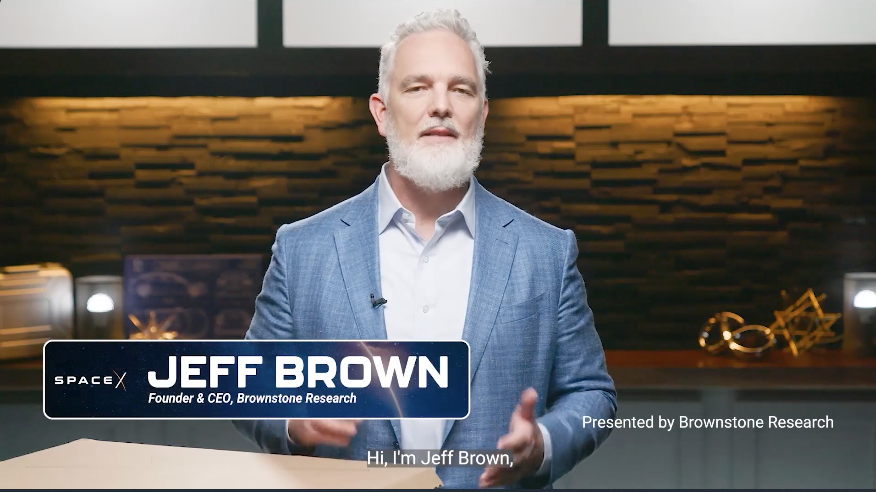
Tech legend Jeff Brown believes he’s building what will be the world’s first global communications carrier.
He predicts this will be Elon’s next trillion-dollar business.
And when it goes public, you could cash out with the biggest payout of your life.
Starlink Snapshot
Satellites in orbit: ~10,000+ (≈60 launched per week)
Coverage: 150+ countries
Gateways planned: 9 in India, expanded presence in Brazil and Africa
Goal: direct-to-device global coverage
The Architecture of the Sky
The expansion has been methodical. In India alone, Starlink is establishing nine gateway earth stations across Mumbai, Noida, Chandigarh, Hyderabad, Kolkata, and Lucknow. These ground-based hubs connect satellites in orbit to terrestrial networks, translating orbital data flow into usable connectivity.
The network's design echoes earlier infrastructure monopolies — the early telephone grid, the interstate highway system, the first submarine cables. It provides not just access but redundancy and resilience. Because Starlink operates independently of ground-based infrastructure, it functions when conventional systems fail: during natural disasters, in conflict zones, or in regions with no terrestrial network to begin with. The service has been deployed on cruise ships, commercial aircraft. It has also become integral to defense operations in Ukraine, where over 200,000 terminals are active.
|
From Service to System
The shift from consumer broadband to full-scale communications infrastructure is already visible. Starlink's direct-to-device technology allows standard smartphones to connect directly to satellites in orbit, bypassing cellular towers entirely. The company’s stated aim: a single account working seamlessly across borders — the world’s first orbit-based network layer.
This centralization carries both geopolitical and economic weight. Starlink is now a critical national security asset for the United States, integrated into defense and emergency communications networks. The Pentagon holds a contract for Starshield, a military-grade version of Starlink, supporting 54 mission partners across the Army, Navy, Air Force, and Coast Guard. The spectrum's resistance to atmospheric interference positions Starlink as the most reliable option for global connectivity in adverse conditions.
Competition exists but lags. Amazon's Project Kuiper has launched 153 satellites as of October 2025, compared to Starlink's 10,000-plus. OneWeb and other rivals face similar scale disadvantages. SpaceX's vertically integrated model — owning satellites, launch services, and ground infrastructure — offers a cost structure no competitor can match. The company's reusable rocket technology has reduced satellite deployment costs by a factor of 100, giving it a structural moat in an industry where capital efficiency determines survival.
The Investment Lens
Revenue projections reflect the transformation. SpaceX is expected to record approximately $15.5 billion in revenue in 2025, with Starlink contributing roughly 70 percent of the total. Morgan Stanley analysts project SpaceX could reach $65 billion in revenue by 2030, with Starlink accounting for 72 percent of sales and 82 percent of net income. The company's valuation currently stands at $350 billion, the highest among private firms globally.
The question is not whether Starlink will dominate satellite communications. That is already happening. The question is whether the infrastructure layer itself becomes a public market opportunity, and when. Musk has indicated that a Starlink IPO will occur once cash flows stabilize.

Partner Resources:
▶ Top Five U.S. Banks Preparing for Massive Change to Checking &Savings Accounts?
(by BROWNSTONE RESEARCH)
▶ Cover all your expenses with just $118,000 invested?
(by INVESTORS ALLEY)
▶ Billionaires & Congress Are Quietly Piling Into This One Sector
(by BEHIND THE MARKETS)
Conclusion
Musk's empire is not loud. It is not consumer-facing in the way Tesla or X commands attention. It is infrastructural. The satellites are visible — 10,000 points of light moving across the night sky — but the opportunity they create is quieter, longer-term, and now unfolding above us. This is not a story about internet speeds or broadband coverage. It is a story about who controls the global flow of information, and at what layer of the stack that control is exercised.
Deniss Slinkins,
Global Financial Journal
